

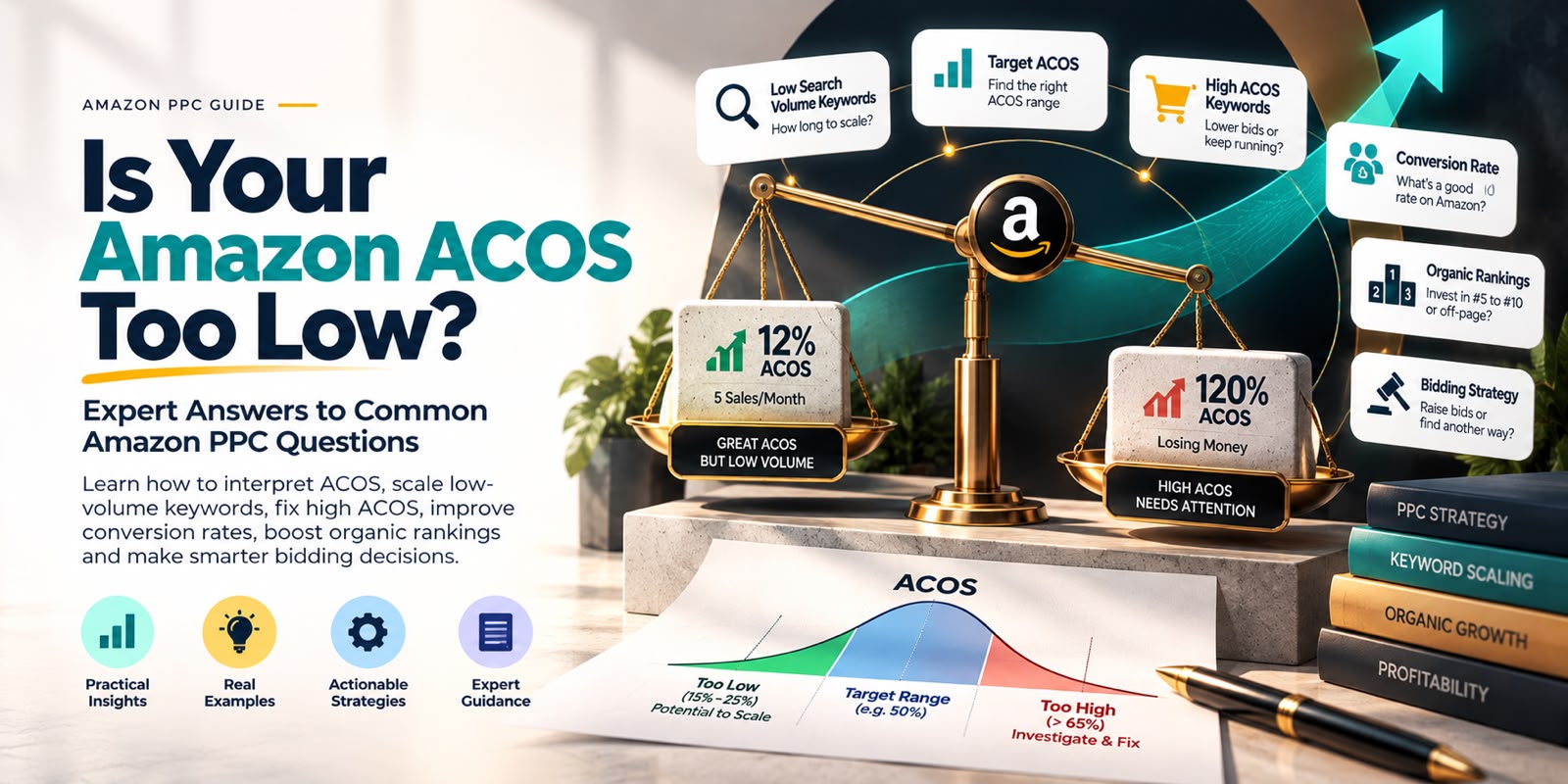
Most Amazon sellers panic when their ACOS is too high. But a very low ACOS can be a problem too. It often means you are leaving sales on the table. Below, I answer the Amazon PPC questions sellers ask me most about ACOS, bids, conversion rates, and organic rank.
1. Is a Low ACOS Always a Good Thing?
Not necessarily. If a keyword has a 12% ACOS, it suggests you may be underspending on it.
Think of it as a bell curve. You have a normal distribution, with the low end on one side, the high end on the other, and the average in the middle. That middle point is your target ACOS.
Let’s say your target ACOS for all campaigns is 50%. You are okay with spending 50 cents in ads for every dollar of ad sales. A keyword with a 12% ACOS is well below that range. It may be performing well, but it could generate more sales if you increase your spend.
What I like to do with any keyword or PPC campaign is use my target ACOS range as a guideline:
- If my target ACOS is 50%, I consider 15% to 25% to be below my target range.
- If something generates a lot of orders at 15% ACOS, that is acceptable.
- If a campaign has an ACOS above 65%, that is something I need to investigate and fix.
- If a campaign is at 20% ACOS against a 50% target, I see it as an underspending opportunity. I can spend more to bring it closer to my target and capture more sales.
The goal is to keep your campaigns and keywords as close to your target ACOS as possible. The ones that are far above or far below your target are where you should focus.
2. What Should You Do With a Keyword That Has a Great ACOS but Very Low Search Volume?
Question: If a keyword has a 12% ACOS but generates only five sales per month, how much time should I spend trying to scale it?
Answer: A low ACOS tells you there is room to spend more, but low search volume limits how far you can scale that keyword.
I would look at the keyword’s search volume, relevance, conversion rate, and available impression share before deciding how much more to invest.
If the keyword is highly relevant and profitable, test increasing the bid or budget gradually. But don’t expect a low-volume keyword to deliver a big jump in sales if the demand simply isn’t there.
Instead, look for closely related keywords with higher search volume that can bring in more sales while keeping an acceptable ACOS.
3. What Would You Do With a Keyword That Generates Sales but Has a Terrible ACOS?
Question: I spend $100 and generate $150 in sales. Should I lower the bid, keep the keyword running, or turn it off?
Answer: Spending $100 to make $150 is roughly a 67% ACOS, which is pretty high. Before you touch it, look at these things:
- Relevance: Is the keyword highly relevant to your product? Some keywords are so relevant that you need to keep them active, even with a high ACOS. In that case, lowering the bid is a good approach.
- Listing quality: Check your listing images and make sure they are effective at converting customers.
- Pricing: Is your product priced competitively? If competitors are advertising the same or similar products for half the price, that can be a major reason customers buy from them instead of you.
Before turning off a keyword, investigate its relevance, bid, conversion rate, listing quality, and pricing.
4. What Is a Good Average Conversion Rate on Amazon, and When Should You Pause a Search Term?
Answer: I would consider a conversion rate of around 10% to 15% to be a decent average, depending on the product and category.
You will always have some keywords with lower conversion rates, and they may still be worth running if they offer room for growth.
I consider a search term underperforming when it starts losing money or has an excessively high ACOS, and I cannot bring the bid down enough to make it profitable. For example, a search term converting at around 4% may not be performing well enough, depending on your product and margins.
Ultimately, evaluate its conversion rate, ACOS, sales volume, and overall profitability before deciding whether to pause it.
5. If You Have an Extra $1,000 to Spend, Should It Go to Keywords Ranking #5 to #10 or Keywords Not on Page One Yet?
Answer: Keywords where you rank between positions #5 and #10 are your strike zone. That is where most of the budget should go.
Pushing these keywords up a few spots can bring you more incremental sales than chasing keywords where you are not even visible yet. Ranking #1 can boost your sales significantly, but you are unlikely to get there just by spending an extra $1,000 over one month.
Once your strike-zone keywords are covered, you can use a smaller part of the budget to push keywords that are close to page one, for example moving a keyword from position #25 toward the first page. Once a keyword reaches page one, it becomes much easier to keep improving its rank.
The goal is to improve your organic rankings and generate incremental sales, not just spend more on keywords that already rank well.
6. If You Lower Your Bid and Your Organic Rank Drops, Should You Raise the Bid Again?
Question: I lowered my bid from $2 to $1.40 and my organic rank dropped from #6 to #12. Should I raise the bid again or look for another way to recover the rank?
Answer: I would probably raise the bid again, but first I would investigate why the organic ranking dropped.
PPC contributes to sales velocity and visibility, so if your organic rank falls sharply after reducing bids, your ads were likely supporting your organic performance. That said, organic rank is also driven by sales performance, conversion rate, relevance, and competition.
Here is how I would approach it:
- Check total sales: Did your overall sales volume drop sharply after the bid cut? If so, you may need to improve your organic conversion performance before cutting ads.
- Reduce bids gradually: Instead of a drastic change, step down from $2 to $1.90, then $1.80, and so on, while watching where your organic rank starts to slip.
- Check if the spend is worth it: If the higher bid generates profitable, incremental sales, raising it again is worthwhile. If it only increases ad costs without meaningful extra sales, look for other ways to improve organic performance.
The goal is to find the right balance between ad spend, organic rankings, and total sales, so your rankings stay stable while your ad spend stays under control.
7. How Should You Evaluate ACOS Across Your Campaigns?
Your target ACOS is the benchmark you use to judge every campaign.
Let’s say your target ACOS is 30%, and you have ten campaigns running at 120% ACOS and another ten at 20% ACOS. Your overall account performance can still be poor, even though half your campaigns look great.
Keep in mind that your overall ACOS is total ad spend divided by total ad sales. It is not a simple average of each campaign’s ACOS percentage. Campaigns with bigger spend pull your account ACOS much more than small ones.
That is why you need to look at how much each campaign contributes to your overall results. Bring the high-ACOS campaigns down, scale the low-ACOS ones up, and keep everything moving toward your target while growing sales and staying profitable.
Final Thoughts
A healthy Amazon PPC account is not about having the lowest possible ACOS. It is about keeping your keywords and campaigns close to your target, scaling the ones that are underspending, and fixing the ones that are bleeding money.
If you want an expert to manage this for you, check out my Amazon PPC Management service. Not sure where your account stands? Start with a PPC Advertising Audit.